
Blog
The FBI Stopped a Terror Plot. But Our Justice System Has a Blind Spot.
The FBI stopped an alleged ISIS-inspired mass shooting at Minnesota’s Mall of America this week. That is good police work, and Americans should be grateful. But one detail deserves more attention: The suspect was just 16 when the FBI first began communicating with him in December 2024. He was 18 when agents arrested him Tuesday.
I spent 20 years as an FBI agent and worked terrorism investigations on a Joint Terrorism Task Force. These cases rarely begin with someone holding a gun. They usually start with fragments: communications, threats, propaganda, relationships, intent and changes in behavior.
Investigators have to determine whether they are looking at angry talk, protected speech, adolescent bravado or someone actually moving toward violence. That’s important because we don’t arrest people simply because they hold disturbing beliefs. Nor should we.
The problem is harder when the person causing concern is a child. Juvenile cases come with different legal rules, charging decisions and policy considerations. Federal prosecutors have traditionally been reluctant to bring young offenders into the federal system when state authorities can appropriately handle the case.
There are good reasons for that. Teenagers make bad decisions, and our justice system recognizes the difference between an adolescent mistake and the conduct of a hardened adult criminal.
Terrorists, however, aren’t checking birth certificates before recruiting someone.
The world teenagers are growing up in has also changed dramatically. When I was growing up, access to the outside world came through rabbit ears on a television set. Today, a teenager with a smartphone can disappear into a rabbit hole of extremist propaganda, graphic violence and people on the other side of the world who know how to exploit anger, isolation or curiosity.
We went from rabbit ears to rabbit holes in a generation.
That does not mean teenagers today are less innocent. It means they are exposed to far more, far earlier, often without an adult knowing what they are seeing. The same phone serving up sports clips, memes and TikTok videos can also deliver violent propaganda and direct access to people looking for vulnerable recruits.
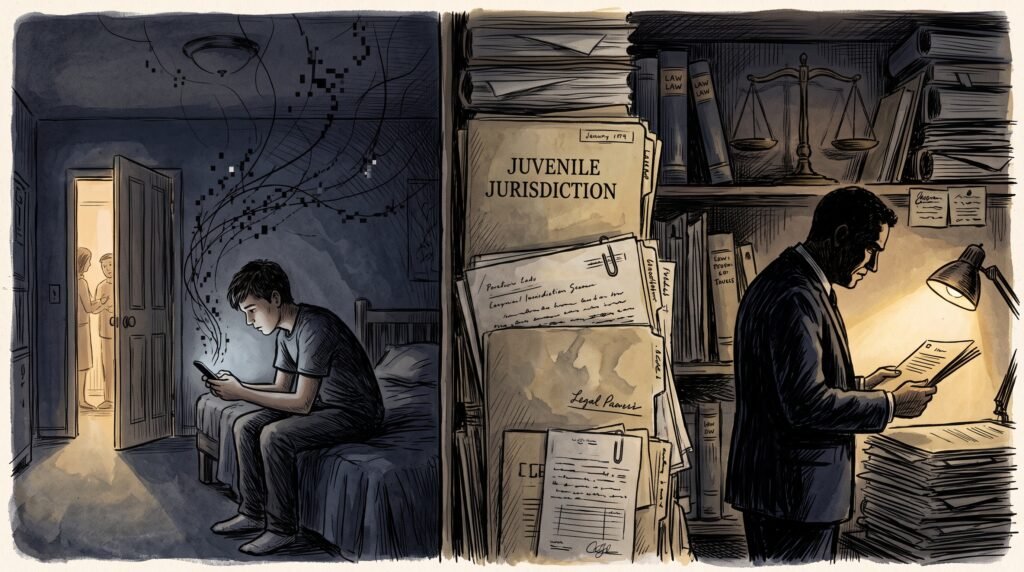
A teenager can sit upstairs in his bedroom while his parents are downstairs watching television and communicate with extremists on another continent, study previous attacks and move deeper into an online world his family may know nothing about.
The law sees a 16-year-old as a juvenile. A terrorist recruiter may simply see someone reachable, impressionable and useful.
The numbers show how rarely the federal system handles juveniles. According to the Administrative Office of the U.S. Courts, only 312 federal juvenile delinquency proceedings were initiated nationwide between 2021 and 2025, barely 62 a year. During the same period, federal courts separately recorded only three juveniles tried as adults.
Those figures cover all federal offenses, not just terrorism, and do not include juveniles prosecuted in state courts or cases handled through other means. But they show how unusual federal juvenile prosecutions are.
The Justice Department’s own guidelines acknowledge that federal juvenile jurisdiction is limited and that state and local systems are generally better equipped to handle young offenders. For much juvenile crime, that makes sense.
I am less convinced it fits when the conduct involves international terrorist organizations, online radicalization and preparations for mass violence. State juvenile systems may have excellent judges, prosecutors and counselors, but they were not designed around ISIS recruitment or violent extremist radicalization.
That leaves investigators with a difficult question: What happens when a 16-year-old is communicating with extremists, expressing an intent to kill and moving toward violence, but the evidence has not yet reached the point where charges are appropriate?
I have worked investigations where the difference between what law enforcement knows, what it can prove and what it can legally act on matters enormously. Concern is not evidence. Suspicion is not probable cause. Intelligence is not always something prosecutors can introduce in court.
Those distinctions protect all of us. But they can also leave investigators asking what meaningful intervention exists before the case becomes an arrest.
None of this means the FBI waited for the Mall of America suspect to turn 18. We simply do not know that. According to the Justice Department, the alleged plot became more specific this year, and agents arrested him after an undercover firearm transaction. The charges remain allegations. Federal law also permits juvenile prosecutions in qualifying circumstances.
Congress and the Justice Department should examine how often juvenile terrorism cases arise, how many are referred to state authorities and what happens after those referrals. They should also ask whether state systems have access to specialists who understand violent extremist radicalization and whether meaningful intervention exists for teenagers moving toward violence before they cross the line into a chargeable federal offense.
There is a basic question of responsibility, too. When a juvenile is escalating toward violence, who owns the problem? If the answer is everybody, there is a risk that in practice it becomes nobody.
The FBI appears to have stopped this alleged plot before anyone was hurt. That is exactly what we want law enforcement to do. But the case should force a harder look at what happens before a juvenile suspect reaches adulthood and before an investigation reaches the point where an arrest can be made.
The people recruiting teenagers into terrorism are not waiting for adulthood. Our thinking about how to stop them should not wait either.
Jason Pack is a retired FBI supervisory special agent who served on a Joint Terrorism Task Force during his 20-year career. He is a national television law enforcement analyst and founder of Media Rep Global Strategies, a crisis communications consultancy.