
Blog
250 Years of First Responders: A Founding American Pledge
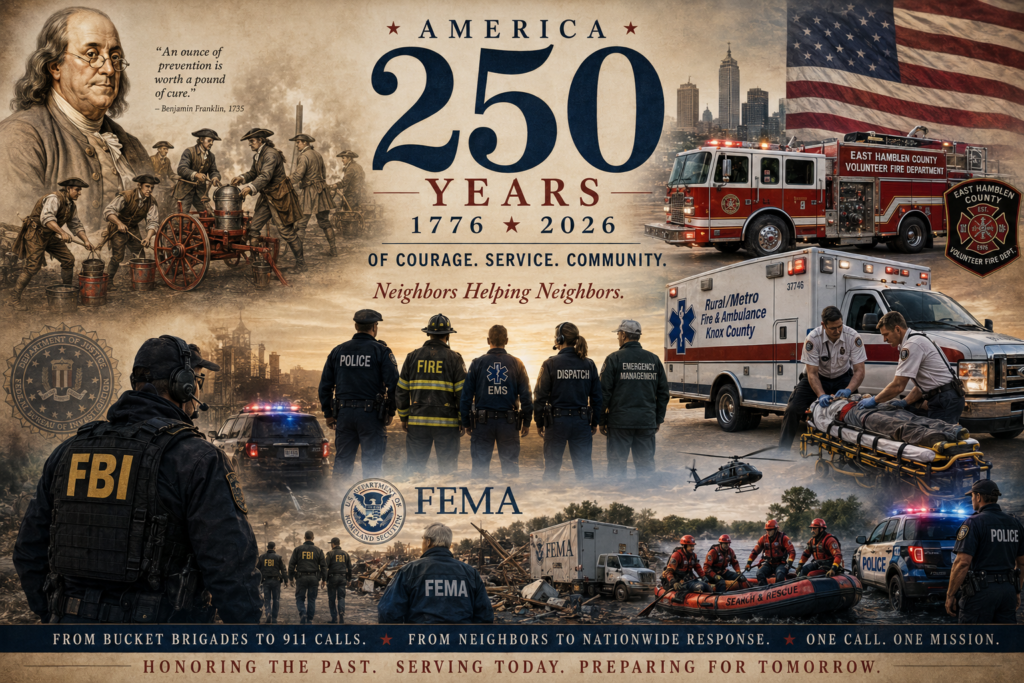
For 250 years, America has been built and rebuilt by the people who show up when the alarm sounds
On a winter night in colonial Philadelphia, fire was announced the old way. Somebody shouted. A church bell rang. Neighbors stumbled out with leather buckets, formed two lines to the nearest well and passed water hand to hand until the flames won or lost. There was no fire department. There was only the town.
Benjamin Franklin watched those bucket lines and saw a problem worth organizing. In 1735, writing in his own newspaper under a borrowed name, he argued that Philadelphia needed trained men working together before the next fire came, and he gave the town a line that outlived him: an ounce of prevention is worth a pound of cure. On Dec. 7, 1736, he and about 30 neighbors formed the Union Fire Company. Each member agreed to keep buckets and salvage bags ready, to come when called and to help any member who suffered loss. Boston had organized mutual fire societies almost two decades earlier, so Franklin’s company was not the first in the colonies. It was something arguably more important. It was a model that spread, company after company, city after city, until volunteering to protect your neighbors became a normal thing an American did.
Look at what those men actually created. They wrote rules. They elected officers. They held each other accountable. Forty years before the Declaration of Independence, ordinary tradesmen were practicing self-government in the most direct way possible, by taking responsibility for one another’s survival. Franklin later helped found the Philadelphia Contributionship, the colonies’ first successful fire insurance company, because he understood that protecting a community takes both courage and structure.
This July Fourth, America turns 250. The story of those two and a half centuries is usually told through presidents, wars and inventions. It can also be told through the people who answer alarms. Every generation of Americans has faced dangers the previous one never imagined, and every generation has built new institutions to meet them. The bucket line became the engine company. The night watchman became the police officer. The funeral home hearse became the paramedic unit. The air raid warden became the emergency manager. Trace any of those lines back far enough and you find the same starting point: neighbors deciding that somebody ought to do something, and then becoming that somebody.
The watch
Policing in America began with an unpopular chore. Boston established a night watch in 1636, and New Amsterdam followed with its rattle watch, men who carried wooden noisemakers to raise the alarm. Watch duty rotated among townsmen, most of whom wanted no part of it. They walked dark streets looking for fire, flood and trouble, and they were as much alarm system as law enforcement.
The lineage has harder chapters. In the Southern colonies during the early 1700s, organized slave patrols formed to control enslaved people, and historians count those patrols as part of the ancestry of American policing. A nation celebrating its 250th birthday owes itself the whole story, because the trust between police and public that we argue about today has roots that run all the way back.
Modern policing arrived from London. In 1829, Sir Robert Peel organized the Metropolitan Police around a radical idea, that officers should prevent crime through visible presence and should draw their authority from public approval rather than force. The principle long associated with his force held that the police are the public and the public are the police. American cities adapted the model, Boston in 1838, New York in 1845, and spent the next century wrestling with corruption, politics and professionalism. Reformers like August Vollmer in Berkeley, California, pushed for trained officers, forensic science and higher standards. In 1910, Alice Stebbins Wells joined the Los Angeles Police Department and became one of the first sworn policewomen in the country, opening a door that took generations to swing wide.
The federal government eventually entered that picture too. In 1908, during Theodore Roosevelt’s presidency, Attorney General Charles Bonaparte quietly hired a small force of investigators for the Department of Justice. They had no name and no building. By July 26 of that year, they had a mission. That force grew into the Federal Bureau of Investigation, which by 1935 had taken the name it carries today. The FBI built the country’s first centralized fingerprint repository, established the National Academy to train local officers, and over the following decades took on organized crime, espionage, kidnapping, terrorism and cybercrime. It also got things badly wrong at times, and the historical record is honest about that too. What the Bureau represents in this story is something the country needed and did not know how to build, a national investigative service for a nation where crime had outgrown county lines. Every generation found new things to ask of it.
Crisis negotiation grew out of hard experience. After the Munich Olympics massacre in 1972 showed the world what happened when negotiation failed, law enforcement began building something more deliberate. The FBI formalized its approach and in 1983 launched the Hostage Rescue Team, trained to resolve the worst situations through both tactical skill and the patience to talk. That combination of talking and readiness, negotiation as the first tool and force as the last, became the standard the rest of the country learned from. The work is still ongoing. Crisis Intervention Teams now operate in police departments across the country, pairing officers with mental health professionals for the calls that need something more than a badge.
Two-way radios, fingerprint files and crime labs transformed local policing too. So did harder lessons. The community policing movement, the counterterrorism mission that followed Sept. 11, 2001, body-worn cameras and de-escalation training all represent the same old struggle in new form, a free country deciding how it wants to be protected. Today roughly 18,000 agencies police America, most of them small departments in small towns, and nearly all of them are struggling to recruit. The badge still gets pinned on a neighbor. It always has.
The engine company
The volunteer fire companies that followed Franklin’s grew more impactful to the communities themselves. They were social clubs, political machines and mutual aid societies rolled into one, and in many towns the firehouse was the center of civic life. Then technology forced a choice. In 1853, Cincinnati put a steam-powered fire engine on the streets and staffed it with paid men, creating what is widely regarded as the nation’s first fully professional fire department. Steam did the work of dozens of volunteers, and the big cities followed Cincinnati one by one.
Catastrophe wrote the curriculum. On the night of Oct. 8, 1871, the Great Chicago Fire killed about 300 people and left a third of the city homeless, and on that same night a firestorm swept through Peshtigo, Wisconsin, killing far more, likely over 1,000, in the deadliest wildfire in American history. Chicago got the legend. Peshtigo got forgotten, which is its own lesson about which emergencies a country chooses to remember. In 1904, fire crews from other cities raced to help Baltimore burn, only to discover their hoses would not fit Baltimore’s hydrants. Much of downtown was lost while equipment sat useless, and the disaster became the founding argument for national standards, an argument every interoperability committee has been having ever since. In 1911, the Triangle Shirtwaist factory fire killed 146 workers, most of them young immigrant women, behind locked doors in New York, and the outrage that followed rewrote fire codes and labor law together.
Today about two-thirds of America’s firefighters are still volunteers, according to National Fire Protection Association data, most of them protecting small and rural communities, and their numbers have been falling for decades. The job itself has changed under them. Most calls now are medical, not fire. The threats that worry today’s firefighters include occupational cancer from contaminated gear and smoke, post-traumatic stress from what the work asks them to see, and wildland fires burning into neighborhoods on a scale Peshtigo’s survivors would recognize.
The neglected disease
For most of American history, if you were badly hurt, your ride to the hospital was whatever could carry a stretcher. During the Civil War, Maj. Jonathan Letterman built the Army of the Potomac an organized ambulance corps, tested under fire at Antietam in 1862, and proved that moving casualties quickly and in order saves lives. Cincinnati’s Commercial Hospital is widely credited with running the first hospital-based civilian ambulance in 1865. Then progress stalled for a century. By the 1950s and 1960s, in much of the country, the local funeral home ran the ambulance, because the hearse was the only vehicle in town long enough for a stretcher. The man driving you to the emergency room might have no training beyond a first aid card, and his employer also sold caskets.
In 1966, the National Academy of Sciences published a report with a blunt title, “Accidental Death and Disability: The Neglected Disease of Modern Society.” It documented that a soldier wounded in Vietnam often had a better chance of skilled care than a driver injured on an American highway. Congress passed the Highway Safety Act that same year, and the federal government began setting standards for ambulances and training.
The proving ground was a neighborhood most of America had written off. In 1967, in Pittsburgh’s Hill District, a partnership between a Black community organization called Freedom House Enterprises and physicians including Dr. Peter Safar, a pioneer of CPR who had lost his own daughter after an asthma attack, began training unemployed Black men and women from the neighborhood to a standard of street medicine that did not exist anywhere else. Freedom House Ambulance Service put its units on the road in 1968 and answered nearly 5,800 calls in its first year. Its medics performed procedures no one had done outside a hospital, and its training program, shaped by Dr. Nancy Caroline, became the foundation for paramedic education nationwide. In 1975, the city shut Freedom House down and folded its territory into a new municipal service that pushed most of its veteran medics aside. The people who invented American paramedicine spent decades left out of its story. Telling it right is the least the country owes them.
Paramedic programs in Miami, Seattle, Los Angeles County and elsewhere carried the model forward, and a television show called “Emergency!” premiered in 1972 and taught the public what a paramedic was. Congress passed the Emergency Medical Services Systems Act in 1973. Today’s paramedics carry ultrasound, administer medications once reserved for physicians and increasingly practice community paramedicine, visiting patients at home to keep them out of the hospital in the first place. Yet in many states EMS still is not designated an essential government service the way police and fire protection are, and agencies across the country are strained by low pay and unfilled shifts. The neglected disease got treated. The treatment system still fights for its own survival.
When the whole town is the emergency
In 1803, after fire devastated Portsmouth, New Hampshire, Congress passed a relief measure often cited as the first federal disaster legislation. For the next 150 years, that was largely the model, disaster by disaster, an act of Congress at a time, with churches, neighbors and groups like the American Red Cross carrying most of the load.
The Cold War changed the scale of imagination. The Federal Civil Defense Administration, created in 1950, gave the country air raid sirens, fallout shelters and duck-and-cover drills, and gave thousands of volunteers an armband and a role. By the 1970s, federal disaster responsibilities were scattered across more than 100 agencies, and the nation’s governors had had enough of it. They asked President Carter to give them one door to knock on. On April 1, 1979, Carter signed Executive Order 12127 creating the Federal Emergency Management Agency, pulling together civil defense, disaster assistance, flood insurance and fire prevention into one organization for the first time.
FEMA was not born ready. Early years brought criticism of staff shortages and unclear mission. Hurricane Andrew in 1992 exposed gaps. But under Director James Lee Witt in the 1990s, the agency professionalized around an all-hazards model, preparing for anything rather than one thing. After Sept. 11, FEMA moved into the new Department of Homeland Security. The FBI’s role in that shift was significant: counterterrorism that had once been treated as a law enforcement matter became a national security mission, and the two agencies learned, sometimes painfully, how to work alongside each other and with state and local partners in ways they never had before. After Hurricane Katrina exposed brutal failures at every level of government in 2005, Congress rebuilt FEMA’s authorities again.
The through line is a profession learning, disaster by disaster, that response is the expensive way to protect people. The National Institute of Building Sciences has found that every dollar spent on hazard mitigation returns between four and eleven dollars in avoided losses, depending on the type of project. The pressure keeps rising. Federal records kept over four decades showed billion-dollar disasters striking more frequently, and the emergency managers of the next 25 years will spend their careers on that curve. The doctrine they now teach is called whole community, and Franklin would have recognized it instantly. It means the plan only works if the neighbors are part of it.
You have to go out
Search and rescue in America began at the water’s edge. In the 1780s, the Massachusetts Humane Society built huts on lonely beaches to shelter shipwreck survivors, and volunteer crews rowed out through surf that had already wrecked stronger boats. The federal government organized the U.S. Life-Saving Service in 1878, staffing stations with surfmen who patrolled beaches on foot through winter storms. Their unofficial creed, as the old surfmen put it, was that you have to go out, but you do not have to come back. In 1915, the service merged into the new U.S. Coast Guard, which has been going out ever since.
Inland, the tradition stayed stubbornly volunteer. The Civil Air Patrol flew coastal watch in World War II, and today most ground search and rescue in America, the teams that find lost hikers, missing children and wandering dementia patients, is performed by trained volunteers who buy much of their own gear. After the 1985 Mexico City earthquake and the 1989 Loma Prieta quake showed what collapsed buildings demand, FEMA organized a national urban search and rescue system whose task forces have worked the rubble of the Oklahoma City bombing, the World Trade Center and disasters since. The FBI’s evidence response teams work alongside those task forces at crime scenes that become disaster sites, and disaster sites that become crime scenes. The line between those two things has not always been clear, and learning to work across it took years of practice. The newest searchers are drones with thermal cameras, which have already located missing people in terrain that would have taken ground teams days to cover. The tools change. The going out does not.
The red phone
Every profession in this story depends on one thing happening first. Somebody has to sound the alarm, and somebody has to hear it. The alarm has been a shout, a church bell, a watchman’s rattle. In 1852, Boston strung the first municipal fire alarm telegraph, and the corner fire box became a fixture of American streets. Police radio arrived in the late 1920s, and for the first time help could be redirected while already moving.
The phone number took longer. Fire chiefs began pushing for a single national emergency number in 1957, a presidential commission endorsed the idea a decade later, and in January 1968 AT&T announced the digits: 911. A small independent phone company in Alabama decided to beat the giant to it. On Feb. 16, 1968, in Haleyville, Alabama, state Rep. Rankin Fite dialed 911 from the mayor’s office, and U.S. Rep. Tom Bevill answered a bright red telephone at the police station across town. Nome, Alaska, followed within a week. It took decades for coverage to spread nationwide, and that red phone still sits in Haleyville as a reminder that one of the most important pieces of public safety infrastructure in American history started in a town of 4,500 people.
Behind the number grew a profession. Dispatchers and 911 telecommunicators talk callers through CPR, childbirth and the worst minutes of their lives, then take the next call without a pause. The federal government still classifies them as clerical workers rather than protective service personnel, a designation their profession has fought for years to change, and anyone who has worked a radio knows which classification is accurate. The communications story also carries hard lessons. On Sept. 11, radio failures contributed to the deaths of firefighters in the towers. The 9/11 Commission documented those failures in detail, and Congress responded in 2012 by creating FirstNet, a dedicated broadband network for first responders. The FBI’s inability to share information across its own offices before Sept. 11 drove reforms inside the Bureau just as the radio failures drove them outside. In both cases, the lesson was the same: people cannot help each other if they cannot talk to each other. Next Generation 911 systems now taking hold can receive texts, and eventually video and data, from people who need help. From a rattle in New Amsterdam to a text message, the alarm keeps evolving, and it has always pointed at the same thing, a human being who will respond.
The next 50 years
Predicting 2076 is a fool’s errand, so here is only what the evidence already supports. Artificial intelligence is being piloted in 911 centers to help triage calls and catch what an exhausted human ear might miss. Police and fire agencies, including an early program in Chula Vista, California, have flown drones as first responders, putting eyes on a scene before the first unit arrives. Robots already go into collapsed structures and hazmat environments that would kill a person. Telemedicine puts a physician in the back of an ambulance parked 60 miles from the nearest hospital. Wearable sensors that monitor a firefighter’s core temperature and heart strain are moving from research into the field. Predictive analytics are improving wildfire and flood warnings. Each of these will grow, though nobody honestly knows which will transform the work and which will quietly disappear, and anyone who claims certainty is selling something.
Two pressures are near certainties. The trend behind more frequent billion-dollar disasters shows no sign of reversing, and cyberattacks have already taken 911 centers offline in American cities, which means the next generation of responders will defend networks as surely as this one defends buildings. The FBI’s cyber mission, which barely existed 30 years ago, now sits at the network of national security. That trend is not slowing down.
The real question about the next 50 years is a human one. Volunteer firefighter ranks keep thinning. Police departments, EMS agencies and dispatch centers report unfilled positions across the country. Studies have found elevated rates of post-traumatic stress and suicide among first responders, and the professions are only beginning to treat mental health as seriously as any other line-of-duty injury. The technology of 2076 will be astonishing. Whether a 22-year-old in 2076 still raises a hand and steps forward depends on choices the country makes now, about pay, about respect, about caring for the people who do the caring.
The pledge
The Declaration of Independence ends with a sentence most Americans never quote. After all the grievances and the grand statements about rights, the signers closed with a promise to one another: “we mutually pledge to each other our Lives, our Fortunes and our sacred Honor.” Strip away the 18th century language and it is a mutual aid pact. The founding document of the United States ends the same way Franklin’s fire company began, with neighbors pledging to show up for each other when it costs something.
That pledge has been kept for 250 years by people whose names mostly never made the histories. The surfman walking a frozen beach. The Hill District medic working a cardiac arrest in a city that would later erase him from the story. The dispatcher coaching a mother through CPR at 3 a.m. The agent knocking on a door in the middle of the night because a child is missing. The FEMA public affairs officer standing at a podium in a town that got hit twice in the same season. The volunteer chief who left three generations of Thanksgiving dinners on the table. The retired nurse who staffs the shelter every time the river rises.
On the night of July 4, 2076, when America turns 300, the fireworks will end and most of the country will go to bed. Somewhere a station’s lights will still be on, a radio will still be up, and somebody will be awake on purpose, waiting to help strangers. Whoever that is, whatever they wear and whatever tools they carry, they will be keeping a promise older than the country itself. The alarm will sound. Someone will go.
Jason Pack has lived the history of American emergency response. He began his journey as a high school volunteer firefighter in 1987 and still serves today as an active Advanced EMT in Knoxville, Tennessee. His federal career spans some of the nation’s most critical chapters, including deploying to Ground Zero with FEMA just two days after the September 11 attacks, and serving 21 years as an FBI Supervisory Special Agent and Crisis Negotiator.
During his time with the Bureau, Jason was the lead communications official for major national incidents, including the Boston Marathon bombing investigation. Jason is currently the Communications Director for a state department of safety and homeland security, CEO of Media Rep Global Strategies, and a national media analyst for Fox News, CNN, NewsNation, and the BBC. He is the author of The Crisis Code: What Leaders Say and Do When Everything Goes Wrong (May 2026).