
Blog
Online Radicalization Has Changed. Here’s Why Americans Should Care
From Lone Wolves to Online Networks
By Jason Pack
Retired FBI Supervisory Special Agent | Founder, Media Rep Global Strategies
Most Americans still think of radicalization as something that happens far away or to someone else.
They picture a young man alone in a basement, watching extremist propaganda, slowly drifting from anger into ideology and, in rare cases, violence. That model still exists. I saw versions of it years ago when I worked terrorism cases as an FBI agent assigned to the Joint Terrorism Task Force.
But the threat environment is changing.
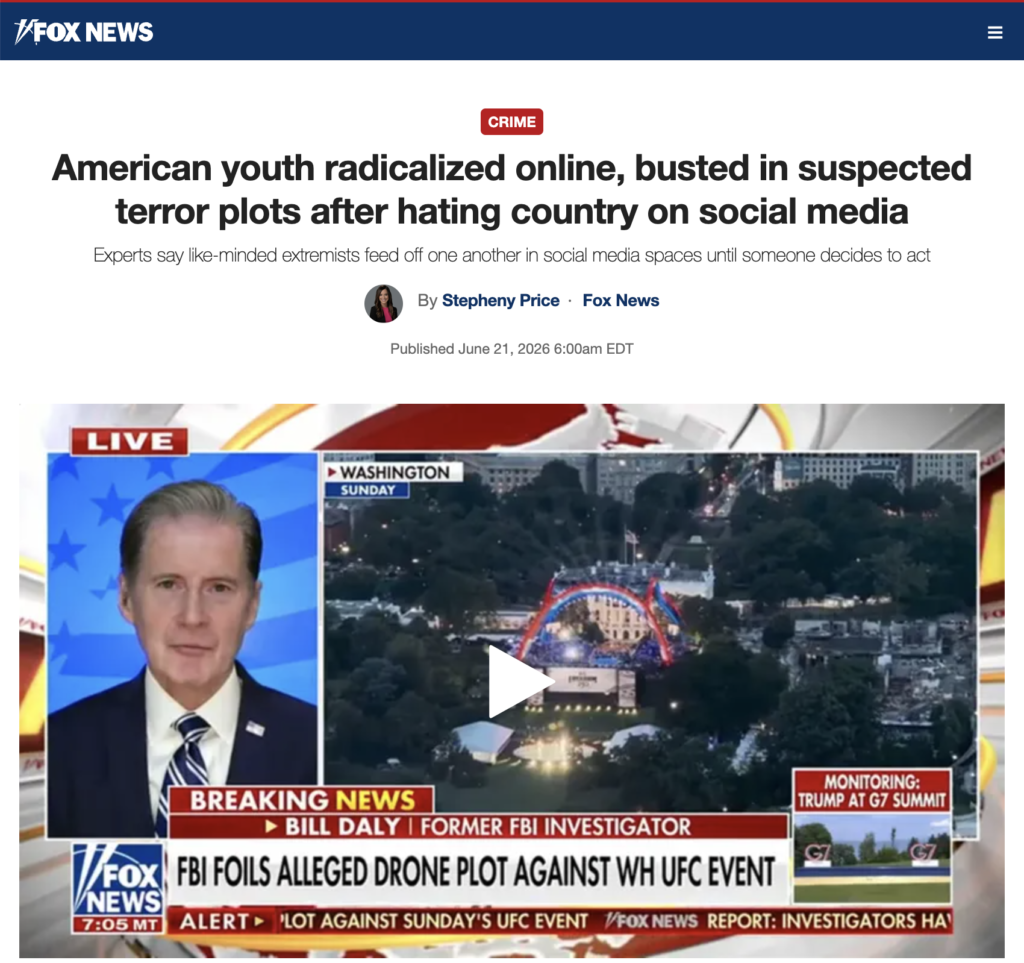
In a recent Fox News Digital article examining several alleged terror plots and online radicalization cases, I discussed what I believe is one of the most important shifts Americans need to understand. Fifteen years ago, many of these cases involved isolated individuals being radicalized alone, often inspired by foreign terrorist organizations.
That still happens. But what we are seeing now can be different. These are often networked conspiracies that assemble online and move fast.
That matters because the internet does more than expose people to extremist ideas. In the wrong environment, it gives isolated and angry people something more powerful than ideology. It gives them belonging, identity and a role.
Someone finds a group on social media or in an encrypted chat. The group validates their anger. They are told they are not crazy, not alone and not powerless. Then they get assigned a purpose.
“You’re the planner.”
“You’re the weapons guy.”
“You handle logistics.”
“You spread the message.”
Suddenly, they matter.
That is the dangerous part.
For many young people who feel isolated, alienated or angry, that sense of purpose can be intoxicating. They may begin by venting. They may start with dark humor, anti-government language, violent memes or hateful rhetoric. But in the wrong group, that language can harden into identity. Identity can turn into commitment. Commitment can become planning.
And planning is where everything changes.
Americans should care about this because online radicalization is not confined to one ideology, one political party or one foreign terrorist movement. It can attach itself to anti-government extremism, foreign terrorist inspiration, political violence, racial hatred or accelerationist thinking. The common denominator is not always the ideology. Often, it is the process.
The process begins with grievance.
A person believes they have been wronged. They believe the country is broken. They believe institutions cannot be trusted. They believe violence may be justified. Then they find others online who reinforce those beliefs around the clock.
That is where social media and encrypted messaging platforms can accelerate the danger. Years ago, radicalization could take time. A person might consume propaganda alone for months or years. Today, a group can form quickly, communicate constantly and create a feedback loop where the most extreme voices gain the most attention.
Peer pressure is powerful in any setting. It is even more powerful when everyone in the group is angry, armed with grievance and pushing one another toward action.
That does not mean every angry online group becomes violent. Most do not. Most people who vent online never move from words to action. Most extremist spaces remain ugly, toxic and dangerous, but still fall short of operational planning.
But when that shift happens, it can happen fast.
That is why parents, teachers, friends, community leaders and law enforcement need to understand the warning signs. The concern is not simply that someone is angry at the government or frustrated with politics. Americans have strong opinions. That is part of who we are.
The concern comes when general anger turns specific.
A young person who spends all night isolated in a room with headphones on may simply be gaming or talking with friends. But if that isolation is paired with sudden secrecy, new extremist vocabulary, intense defensiveness, unusual interest in tactical gear or weapons, and a new online peer group no one in the family knows, it deserves attention.
The biggest warning sign is movement from grievance to planning.
There is a major difference between someone saying, “The government is broken,” and someone researching specific people, addresses, security patterns, event locations or tactical vulnerabilities. That is no longer ordinary venting. That begins to look like operational behavior.
In the Fox News Digital article, I said the real shift occurs when someone moves from complaining about the government in general to researching specific people, specific addresses and specific security patterns. That is way more than venting. It is getting into planning.
That is the line families and communities need to understand.
This issue also forces us to take a hard look at our national culture. We have normalized a lot of hate talk in this country. That is true across the political spectrum. Too often, people are rewarded for saying the cruelest thing, making the most extreme accusation or treating fellow Americans as enemies instead of neighbors.
That kind of environment does not cause every act of violence. But it creates soil where alienation, anger and extremism can grow.
Young people are especially vulnerable when they lack strong real-world connections. A disconnected young person who feels invisible may be drawn to a group that offers identity and mission. When that mission is wrapped in violence, chaos or fantasies of collapse, the danger becomes real.
One particularly concerning strain is accelerationist thinking. This is different from normal political disagreement. It is not about winning an election or arguing policy. It is the belief that the system cannot be fixed and must be destabilized or destroyed. The goal is chaos.
Parents and loved ones should listen for that kind of language.
“The system has to fall.”
“Nothing can be fixed.”
“We need chaos.”
“It all has to burn.”
Those phrases alone do not prove someone is planning violence. But combined with isolation, weapons interest, encrypted communications, new extremist peers and specific research, they should raise serious concern.
There is also a hopeful lesson in these cases. Family members matter.
In many investigations, the first warning does not come from a federal agency, a social media company or an intelligence product. It comes from a parent, sibling, friend, teacher or neighbor who sees something change and decides to speak up.
That takes courage.
Nobody wants to believe someone they love could be drifting toward violence. Nobody wants to overreact. But calling attention to concerning behavior can save lives, including the life of the person being radicalized. This is not about criminalizing unpopular opinions. It is also not about treating every angry teenager as a threat. This is really about recognizing when anger begins to organize itself into action.
Americans should care because the front line of public safety has moved. It is no longer only at airports, government buildings or large public events. It is also in bedrooms, gaming chats, private messages, encrypted apps and online communities where vulnerable people can be pulled into something dangerous before the rest of the world sees it coming.
The answer is not panic. The answer is awareness.
Families need to stay engaged. Communities need to rebuild real connection. Schools and law enforcement need trusted relationships that allow concerns to be shared early. Technology companies need to take real-world threats seriously. And all of us need to lower the temperature in the way we talk about our country and one another.
Most online anger will never become violence. But when anger becomes identity, identity becomes belonging and belonging becomes a mission, the risk changes quickly.
That is why this matters.
Because by the time an online conspiracy becomes an operational plot, the warning signs were often already there. The question is whether someone close enough to see them had the courage to act.