
Blog
Venezuela’s 72-Hour Clock Is Running and the Right Teams Are on the Way
By Jason Pack, AEMT/FF | Retired FBI Supervisory Special Agent | Former FEMA External Affairs Officer | Author, The Crisis Code
The clock started Wednesday evening. It does not stop for damaged airports or aftershocks. It just runs. And right now it is running against people who are still alive under that rubble.
Two earthquakes hit Venezuela back to back. A 7.2, then 39 seconds later a 7.5. Most Americans think of Loma Prieta in 1989 as a big earthquake. That was a 6.9. It killed 63 people in San Francisco with every advantage a modern city can offer. Venezuela’s first quake Wednesday was already stronger than that. The second one was in a different category altogether.
Hundreds of buildings are down. Each one is a rescue scene. Each scene needs trained people, specialized equipment, and time. Time is the thing nobody has enough of.
The airport is damaged and closed. That is the central problem right now. USAR teams do not travel light. They bring dogs, listening equipment, cameras that snake through rubble, hydraulic tools that can move concrete without killing the person trapped underneath it. Getting all of that in country without the main airport is a logistics puzzle that the military is working around the clock to solve. Every hour that puzzle takes is an hour the clock keeps running.
More than 130 aftershocks have hit since Wednesday. Every one of them stops everything. You pull your people out. You wait. You check the structure. Then you go back in. Over and over. It eats time that survivors may not have.
The Right People Are Going
Here is the good news. The United States sent the right people.
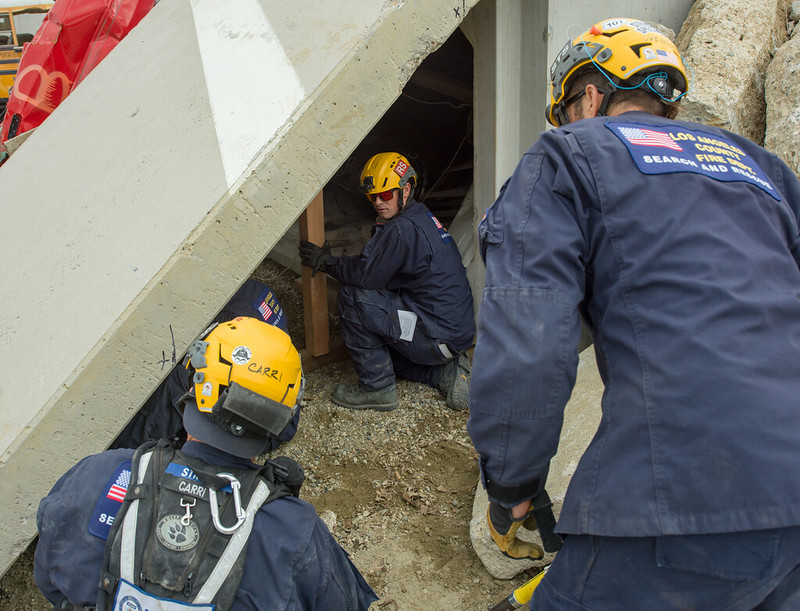
Secretary Rubio confirmed the deployment of the Fairfax County Urban Search and Rescue Team and the Los Angeles County Fire Department Urban Search and Rescue Team 2. Those are not just good teams. They are the best we have.
People hear firefighter and think they understand what that means. Your neighborhood firefighter is exceptionally well trained for most anything that career will throw at them. But structural collapse rescue is something else entirely. These USAR teams train specifically for pancake collapses, for void space rescue, for pulling people out of environments that should not still be standing. Each team brings up to 60 people, four trained search dogs, and 50,000 pounds of equipment. Hydraulic concrete breakers. Saws. Torches. Drills. Advanced field medical gear. Fifty thousand pounds per team. That tells you what kind of work this is.
The Fairfax team worked Ground Zero after September 11th. I was there beside them. I watched them work. They have been to earthquakes overseas and major collapses here at home. They have found people alive when every reasonable calculation said the window was gone.
The people on those scenes when the Americans arrive will be Venezuela’s Bomberos, their local fire brigades, and Protección Civil, their civil defense agency. These men and women have been working that rubble with hand tools since Wednesday evening. They showed up and they stayed. What they need now is the heavy equipment and specialized training that only an internationally certified USAR team can bring.
The System Behind the Teams
The State Department has a Disaster Assistance Response Team, a DART, on the ground coordinating everything. The DART is the traffic cop for the whole operation. Without it, help piles up in the wrong place. Resources go where they are not needed and miss where they are. The DART keeps that from happening.
Samaritan’s Purse is already there. Catholic Relief Services. World Vision. The International Rescue Committee. These organizations do not wait for perfect conditions. They move into broken places and they work. They are feeding rescue workers, treating the injured, and taking care of thousands of people who are not trapped but have nowhere to go because their home is now a pile of concrete.
The military is flying equipment in on routes that do not depend on the damaged airport. Two U.S. Navy ships, the USS Fort Lauderdale and the USS Billings, are moving closer to Venezuela to support the effort. U.S. Southern Command has a Marine general on the ground in Caracas overseeing the Pentagon’s role. The pieces are moving.
Why There Is Still Reason to Hope
Here is what experience also teaches. People survive things that the math says they should not.
After the Haiti earthquake in 2010, a 16-year-old boy came out of the rubble alive after 15 days. A woman was recovered after 27 days. After the Turkey earthquake in 2023, survivors were pulled out more than 200 hours after it hit.
That happens because of physics and because of trained people who refuse to quit. Even in the worst collapses, void spaces form. A beam catches a slab. A stairwell holds. A refrigerator takes a load off a ceiling and leaves a pocket of air underneath it. Small spaces. But real ones. And right now people are alive in them.
The Fairfax team knows that. The LA County team knows that. Venezuelan Bomberos who have not left those scenes since Wednesday night know that. The DART is coordinating the flow. Samaritan’s Purse and the other voluntary agencies are supporting the people those rescue teams cannot reach yet.
The airport will reopen. The aftershocks will slow down. Those are recovery problems and recovery problems get solved.
The rescue problem has a deadline. The teams on those scenes know it better than anyone.
Somewhere in that rubble somebody is tapping on a pipe.
Somebody up top is listening.
Jason Pack spent 30 years in emergency services, starting as a firefighter and Advanced EMT. He served as a FEMA external affairs officer and worked alongside USAR task forces at Ground Zero after September 11, 2001. He saw firsthand what those teams do and what it costs them to do it. He later spent 21 years as an FBI Supervisory Special Agent and now advises on crisis communications through Media Rep Global Strategies. He is the author of The Crisis Code: Leadership, Strategy, and Communication When Everything Goes Wrong.